JavaScript is disabled in your browser. Please enable JavaScript to view this website.
AB118184

Catalase Activity Assay Kit (Immunocapture)

Catalase Activity Assay Kit (Immunocapture)

Be the first to review this product! Submit a review

|

(12 Publications)

Catalase Activity Assay Kit ab118184 is used to determine the relative specific activity (activity and quantity) of catalase in a sample.

別名を表示する

Catalase, CAT
5 Images
Functional Studies - Catalase Activity Assay Kit (Immunocapture) (AB118184)
  • FuncS

Supplier Data

Functional Studies - Catalase Activity Assay Kit (Immunocapture) (AB118184)

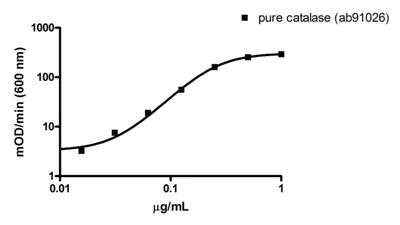
Example standard curve for the purified human catalase sample ab91026.

Functional Studies - Catalase Activity Assay Kit (Immunocapture) (AB118184)
  • FuncS

Supplier Data

Functional Studies - Catalase Activity Assay Kit (Immunocapture) (AB118184)

Example relative specific activity – comparing the activity and quantity of purified erythrocyte catalase (ab91026) and catalase from human hepg2 lysate. The HepG2 sample is determined to have a higher specific activity rate.

Functional Studies - Catalase Activity Assay Kit (Immunocapture) (AB118184)
  • FuncS

Supplier Data

Functional Studies - Catalase Activity Assay Kit (Immunocapture) (AB118184)

Example standard curve for the purified human catalase sample ab91026.
Functional Studies - Catalase Activity Assay Kit (Immunocapture) (AB118184)
  • FuncS

Supplier Data

Functional Studies - Catalase Activity Assay Kit (Immunocapture) (AB118184)

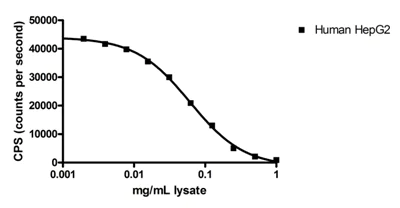
Example sample curves demonstrating the working range of the assay for a human and cultured cell line lysate (HepG2).

Functional Studies - Catalase Activity Assay Kit (Immunocapture) (AB118184)
  • FuncS

Supplier Data

Functional Studies - Catalase Activity Assay Kit (Immunocapture) (AB118184)

Example sample curves demonstrating the working range of the assay for a human and cultured cell line lysate (HepG2).

Key facts

サンプルタイプ

Cell culture extracts, Tissue Extracts

交差種

Mouse, Rat, Human

アッセイタイプ

Enzyme activity

検出範囲

1 - 1000 µg/mL

アッセイ時間

6h

アッセイプラットフォーム

Microplate reader

Reactivity data

{ "title": "Reactivity Data", "filters": { "stats": ["", "Reactivity", "Dilution Info", "Notes"] }, "values": { "Enzyme activity assay": { "reactivity":"TESTED_AND_REACTS", "dilution-info":"", "notes":"<p></p>" } } }

製品の詳細

Catalase Activity Assay Kit ab118184 is used to determine the relative specific activity (activity and quantity) of catalase in a sample. Capture antibodies specific for catalase are pre-coated in the microplate wells. The native enzyme is immunocaptured within the wells of the microplate; this removes all other enzymes.

The catalase assay buffer contains hydrogen peroxide which reacts with a substrate to make a luminescent product. Catalase functions rapidly to remove hydrogen peroxide from the solution and reduce the production of light. Therefore the light produced in each well is inversely proportional to the amount of catalase activity.

After catalase activity measurement the quantity of catalase is measured by adding an anti-catalase detector antibody to each well. After washing away unbound detector antibody, HRP-conjugated label specific for the detector antibody is pipetted to the wells. The wells are again washed, a TMB substrate solution is added to the wells and color develops in proportion to the amount of catalase bound. The developing blue color is measured at 600 nm. Optionally the reaction can be stopped by adding hydrochloric acid which changes the color from blue to yellow and the intensity can be measured at 450 nm.

Catalase assay protocol summary:
- add samples to wells
- incubate for 3 hrs at room temp
- wash with wash buffer
- add activity solution and hydrogen peroxide solution
- analyze with luminescence microplate reader for 30 min
- wash
- add detector antibody and incubate for 1 hr at room temp
- wash
- add HRP label and incubate for 1 hr at room temp
- wash
- add HRP development solution and analyze with microplate reader for 15 min in kinetic mode

REACH authorisation
Abcam has not and does not intend to apply for the REACH Authorisation of customers' uses of products that contain European Authorisation list (Annex XIV) substances.
It is the responsibility of our customers to check the necessity of application of REACH Authorisation, and any other relevant authorisations, for their intended uses.

精度

[ { "reproducibilityType": "Inter", "sample": "Sample 1", "replicates": 4, "mean": null, "standardDeviation": null, "coefficientOfVariability": "9.9" }, { "reproducibilityType": "Intra", "sample": "Sample 1", "replicates": 8, "mean": null, "standardDeviation": null, "coefficientOfVariability": "7.1" } ]

製品内容

{ "values": { "1x96Tests": { "sellingSize": "1 x 96 Tests", "publicAssetCode":"ab118184-1x96Tests", "assetComponentDetails": [ { "size":"1 x 0.2 mL", "name":"200X Luiminescent reagent", "number":"AB118184-CMP04", "productcode":"" }, { "size":"1 x 1.5 mL", "name":"10X HRP Label", "number":"AB118184-CMP02", "productcode":"" }, { "size":"1 x 0.5 mL", "name":"60X Hydrogen Peroxide", "number":"AB118184-CMP08", "productcode":"" }, { "size":"1 x 0.5 mL", "name":"55X Coupler", "number":"AB118184-CMP07", "productcode":"" }, { "size":"1 x 1.5 mL", "name":"10X Detector Antibody", "number":"AB118184-CMP11", "productcode":"" }, { "size":"1 x 15 mL", "name":"Extraction Buffer (ab260490)", "number":"AB118184-CMP06", "productcode":"" }, { "size":"1 x 10 mL", "name":"10X Blocking Solution", "number":"AB118184-CMP10", "productcode":"" }, { "size":"1 x 24 mL", "name":"Base Buffer", "number":"AB118184-CMP09", "productcode":"" }, { "size":"1 x 20 mL", "name":"20X Buffer", "number":"AB118184-CMP05", "productcode":"" }, { "size":"1 x 12 mL", "name":"HRP Development Solution", "number":"AB118184-CMP01", "productcode":"" }, { "size":"1 x 1 Unit", "name":"96-Well Microplate", "number":"AB118184-CMP03", "productcode":"" } ] } } }

出荷温度及び保存条件

出荷温度
Blue Ice
短期保存温度
+4°C
長期保存温度
+4°C
保管に関する情報
+4°C

補足情報

This supplementary information is collated from multiple sources and compiled automatically.

Catalase also known as CAT is an enzyme that catalyzes the decomposition of hydrogen peroxide into water and oxygen. This enzyme has a molecular weight of approximately 240 kDa and typically forms a tetramer. Catalase mainly resides in peroxisomes functioning as a peroxisome marker. It expresses abundantly in the liver kidneys and erythrocytes where it plays significant roles in cellular protection against oxidative damage. The presence of Catalase makes it an ideal candidate for use in peroxisome staining and peroxisome image analysis in research.
Biological function summary

Catalase contributes to antioxidant defense by breaking down hydrogen peroxide preventing cellular damage. In peroxisomes it works alongside other peroxisomal enzymes to maintain cell health and metabolic regulation. Catalase does not form a complex but interacts closely with other enzymes like superoxide dismutase which dismutates superoxide radicals into less harmful substances. Increased Catalase activity levels can be measured using Catalase activity kits and activity assays allowing us to learn about peroxisome function.

Pathways

Hydrogen peroxide removal by Catalase is vital in the reactive oxygen species (ROS) metabolic process and plays a part in the cellular response to oxidative stress. Catalase interacts with the glutathione peroxidase pathway safeguarding cells from oxidative stress-related damage. Superoxide dismutase works synergistically with Catalase transforming superoxide anions into hydrogen peroxide before its decomposition by Catalase. These activities highlight the essential role Catalase plays in protecting cells from oxidative stress damage.

Catalase relates to conditions like acatalasemia and diabetes. Acatalasemia a condition caused by a deficiency of Catalase increases the risk of developing diabetes and other oxidative stress-related diseases. Mutations in the CAT gene can lead to decreased Catalase activity contributing to the onset of these conditions. Additionally Catalase works with other proteins like glutathione peroxidase in mitigating the effects of oxidative stress with deficiencies potentially exacerbating complications in diabetes management.

製品プロトコール

ターゲットの情報

Catalyzes the degradation of hydrogen peroxide (H(2)O(2)) generated by peroxisomal oxidases to water and oxygen, thereby protecting cells from the toxic effects of hydrogen peroxide (PubMed : 7882369). Promotes growth of cells including T-cells, B-cells, myeloid leukemia cells, melanoma cells, mastocytoma cells and normal and transformed fibroblast cells (PubMed : 7882369).
See full target information Catalase

文献 (12)

Recent publications for all applications. Explore the full list and refine your search

Chemical biology & drug design 105:e70142 PubMed40556500

2025

Apelin-13 Protects Against Airway Inflammation, Oxidative Stress, and Epithelial-Mesenchymal Transition in a Chronic Asthma Model.

Applications

Unspecified application

Species

Unspecified reactive species

Huifeng Sun,Ai Wang,Nan Shi

RSC advances 15:20143-20167 PubMed40519680

2025

Exploration of the anticancer efficacy of a novel 1,3-thiazole analog in an ehrlich ascites carcinoma model: and insights into hepatorenal protective potentials the modulation of apoptosis, oxidative stress and inflammation.

Applications

Unspecified application

Species

Unspecified reactive species

Mohammed El Behery,Dina M Abo-Elmatty,Maha Alsunbul,Yassmina I Mohey El-Deen,Doaa I Mohamed,Emad Rashad Sindi,Maha H Hashem,Ebtesam Al-Olayan,Ibrahim Abdel Aziz Ibrahim,Ghazi A Bamagous,Suraj Mali,Essa M Saied

Immunity, inflammation and disease 13:e70111 PubMed39807748

2025

The Protective Effects of Annexin A1 in Acute Lung Injury Mediated by Nrf2.

Applications

Unspecified application

Species

Unspecified reactive species

Hui Huang,Yuqin Shi,Yuequan Zhou

Oxidative medicine and cellular longevity 2020:7126976 PubMed32256960

2020

Chidamide Inhibits Glioma Cells by Increasing Oxidative Stress via the miRNA-338-5p Regulation of Hedgehog Signaling.

Applications

Unspecified application

Species

Unspecified reactive species

Haixia Zhou,Liang Han,Han Wang,Jun Wei,Zhigang Guo,Zhaohui Li

Neurotoxicity research 36:472-490 PubMed31187430

2019

The Long-Term Impairment in Redox Homeostasis Observed in the Hippocampus of Rats Subjected to Global Perinatal Asphyxia (PA) Implies Changes in Glutathione-Dependent Antioxidant Enzymes and TIGAR-Dependent Shift Towards the Pentose Phosphate Pathways: Effect of Nicotinamide.

Applications

Unspecified application

Species

Unspecified reactive species

C Lespay-Rebolledo,A Tapia-Bustos,D Bustamante,P Morales,M Herrera-Marschitz

Colloids and surfaces. B, Biointerfaces 171:707-714 PubMed30054048

2018

Comparison of the antioxidant activity of catalase immobilized on gold nanoparticles via specific and non-specific adsorption.

Applications

Unspecified application

Species

Unspecified reactive species

Ewa Czechowska,Katarzyna Ranoszek-Soliwoda,Emilia Tomaszewska,Agnieszka Pudlarz,Grzegorz Celichowski,Dorota Gralak-Zwolenik,Janusz Szemraj,Jaroslaw Grobelny

International journal of molecular medicine 42:2260-2268 PubMed30015834

2018

Potential repositioning of GV1001 as a therapeutic agent for testosterone‑induced benign prostatic hyperplasia.

Applications

Unspecified application

Species

Unspecified reactive species

Kyeong Seok Kim,Hun Yong Yang,Seung-Cheol Chang,Young-Mi Kim,Kwang Youl Lee,Byung Mu Lee,Hyung Sik Kim

Neurotoxicity research 34:660-676 PubMed29959728

2018

Regionally Impaired Redox Homeostasis in the Brain of Rats Subjected to Global Perinatal Asphyxia: Sustained Effect up to 14 Postnatal Days.

Applications

Unspecified application

Species

Unspecified reactive species

Carolyne Lespay-Rebolledo,Ronald Perez-Lobos,Andrea Tapia-Bustos,Valentina Vio,Paola Morales,Mario Herrera-Marschitz

Toxicological sciences : an official journal of the Society of Toxicology 164:428-438 PubMed29718361

2018

Alcohol Metabolism in the Progression of Human Nonalcoholic Steatohepatitis.

Applications

Unspecified application

Species

Unspecified reactive species

Hui Li,Erica Toth,Nathan J Cherrington

Frontiers in pharmacology 9:372 PubMed29725297

2018

1-Deoxynojirimycin (DNJ) Ameliorates Indomethacin-Induced Gastric Ulcer in Mice by Affecting NF-kappaB Signaling Pathway.

Applications

Unspecified application

Species

Unspecified reactive species

Xuehua Piao,Shuangdi Li,Xiaodan Sui,Lianyi Guo,Xingmei Liu,Hongmei Li,Leming Gao,Shusheng Cai,Yanrong Li,Tingting Wang,Baohai Liu
View all publications
websiteProtocolBooklet
en

Abcam product promise

当社は、高品質な試薬を通じてお客様の研究を力強くサポートすることをお約束いたします。ご使用いただく各段階で、常にお客様をサポートできる体制を整えております。万が一、製品が期待通りに機能しない場合は、「Abcam Product Promise」による当社保証制度に基づき、安心してご利用いただけます。
保証に関する詳細については利用規約をご確認ください。

Please note: All products are 'FOR RESEARCH USE ONLY. NOT FOR USE IN DIAGNOSTIC OR THERAPEUTIC PROCEDURES'.

For licensing inquiries, please contact partnerships@abcam.com